The Medicine Maker
  • Explore

    Explore

    • Latest
    • Features
    • Interviews
    • Business & Trends
    • Technology & Manufacturing
    • Product Profiles
    • White Papers

    Featured Topics

    • Biopharma
    • Small Molecules
    • Cell & Gene
    • Future of Pharma

    Issues

    • Latest Issue
    • Archive
    • Cell and Gene Therapy Supplement
  • Topics

    Topics

    • Cell & Gene
    • Bioprocessing
    • Drug Delivery
    • Drug Discovery
    • Development & Clinical
    • Formulation
    • Facilities & Equipment
    • Outsourcing
    • Packaging
    • Regulation & Standards
    • Small Molecules
    • Supply Chain
  • News & Blogs

    News & Blogs

    • Industry News
    • Research News
    • Blogs
  • Events
    • Live Events
    • Webinars
  • Community & Awards

    Community & Awards

    • Power List
    • Sitting Down With
    • Innovation Awards
    • Company of the Year Awards
    • Authors & Contributors
  • Multimedia
    • Video
    • eBooks
    • Content Hubs
Subscribe
Subscribe
The Medicine Maker / Issues / 2018 / Jan / Perfecting Perfusion
Manufacture Bioprocessing Biopharma Sponsored

Perfecting Perfusion

By Delia Lyons 01/02/2018 1 min read

Sponsored By

Share

As the need for smaller plants, flexible manufacturing and competition intensifies in the biopharma industry, so does the need for intensified processes. Increased speed to market, reduced cost of goods and increased volumetric productivity are some of the benefits offered by perfusion cell cultures. For a perfusion process to be economically feasible, high cell densities need to be attained with low volume of cell culture medium. Achieving and maintaining steady-state conditions with low perfusion rates require specific media – ideally fine-tuned to the needs of the particular perfusion application. For example, in an N-1 bioreactor, maximized high growth rates and viability are required. In contrast, in a production bioreactor, such high growth rates may be detrimental, due to increased bleed rates and associated product loss. A high performing perfusion cell culture medium needs to not only provide the required nutrients, but also to minimize the generation of toxic by-products. A critical step, therefore, is to appropriately balance and optimize perfusion media according to the metabolic needs of each specific process – and steady-state perfusion is the most challenging of these applications.
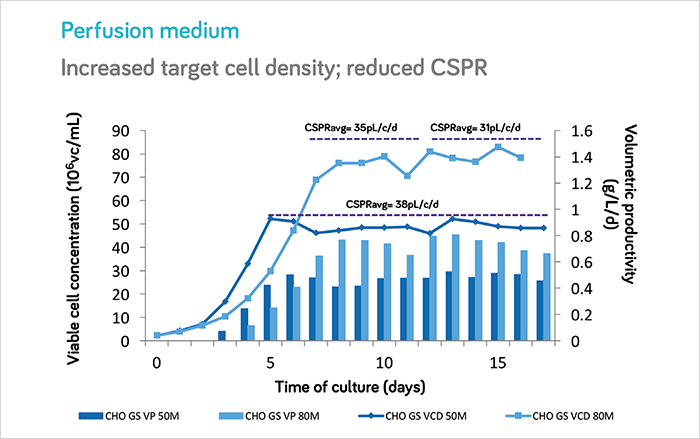
Steady-state maintained at 80x106vc/mL at 2vvd.
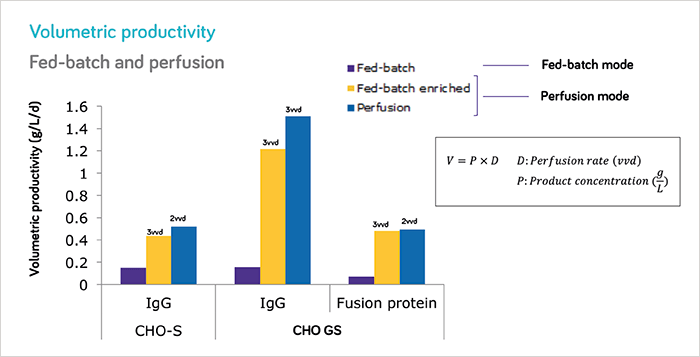
Up to ~10-fold increase volumetric productivity in perfusion when compared to fed-batch; higher volumetric productivity and/or lower perfusion rates using perfusion catalog than using enriched fed-batch medium.

At Merck, we have developed a catalog CHO cell perfusion medium specifically designed for intensified perfusion processes, including steady-state. We developed this novel cell culture medium with seven different industrially-relevant CHO cell lines producing various types of proteins. The results at bench-top bioreactor scale have been excellent. In particular, we have found significant differences between our perfusion medium and enriched fed-batch medium (EFBM): the new product allows us to simultaneously increase volumetric productivity, as compared to EFBM, while at the same time increasing specific productivity and reducing cell-specific perfusion rate (CSPR) from 80 to 40 picoliters per cell per day in steady-state. In non-steady-state applications, CSPRs lower than 20 picoliters per cell per day have been generally achieved. The flexibility of perfusion technology is apparent at two levels. On the one hand, variable drug production amounts can be achieved with the same equipment just by modifying the duration of a steadystate perfusion run. On the other hand, perfusion can be processed for different applications such as a tool for high density cryopreservation, for N-1 bioreactor intensification, or as production bioreactor. The breadth of applications as a production bioreactor is quite extensive as well, varying from steady-state and dynamic perfusion to different types of perfusion/fed-batch hybrid systems. Studies show the potential economic advantage of perfusion and continuous manufacturing overall, compared to batch-based processes. Ultimately, the choice between any of the types of perfusion, fed-batch or hybrid processes will depend on many factors that relate to the specific manufacturing plant and drug being manufactured.

Newsletters

Receive the latest pharmaceutical news, personalities, education, and career development – weekly to your inbox.

Newsletter Signup Image

About the Author(s)

Delia Lyons

Delia Lyons is Head of Perfusion Media Development, at Merck.

More Articles by Delia Lyons

Recommended

Related Content

Video: Sitting Down With… Delara Motlagh
Cell & Gene Bioprocessing Outsourcing
Video: Sitting Down With… Delara Motlagh

November 13, 2026

1 min read

Fujifilm Cellular Dynamics’ Delara Motlagh discusses her path into cell and gene therapy, the challenges of scaling manufacturing, and the potential of iPSC technologies

Lonza to Acquire Five US CDMO Sites from Merck KGaA
Biopharma Bioprocessing Industry News
Lonza to Acquire Five US CDMO Sites from Merck KGaA

November 11, 2026

2 min read

The deal adds viral vector, bioconjugation, payload-linker, and advanced drug-delivery capabilities to Lonza’s manufacturing network

Is Pharma Building the Right Facilities for Future Biologics?
Bioprocessing Facilities & Equipment Biopharma
Is Pharma Building the Right Facilities for Future Biologics?

November 9, 2026

5 min read

As biologics portfolios expand and average product volumes fall, Miriam Monge asks whether today’s major manufacturing investments offer the flexibility tomorrow’s market will require

What Will It Take to Control Continuous Biomanufacturing
Bioprocessing Biopharma Research News
What Will It Take to Control Continuous Biomanufacturing?

November 2, 2026

2 min read

Review examines how PAT, model-based control, reinforcement learning, and digital twins could maintain product quality from perfusion culture through downstream purification

The Medicine Maker
Subscribe

About

  • About Us
  • Work at Conexiant Europe
  • Terms and Conditions
  • Privacy Policy
  • Your Privacy Choices
  • Advertise With Us
  • Contact Us

Copyright © 2026 Texere Publishing Limited (trading as Conexiant), with registered number 08113419 whose registered office is at Booths No. 1, Booths Park, Chelford Road, Knutsford, England, WA16 8GS.

Affiliations:

Specialties:

Areas of Expertise:

Contributions: