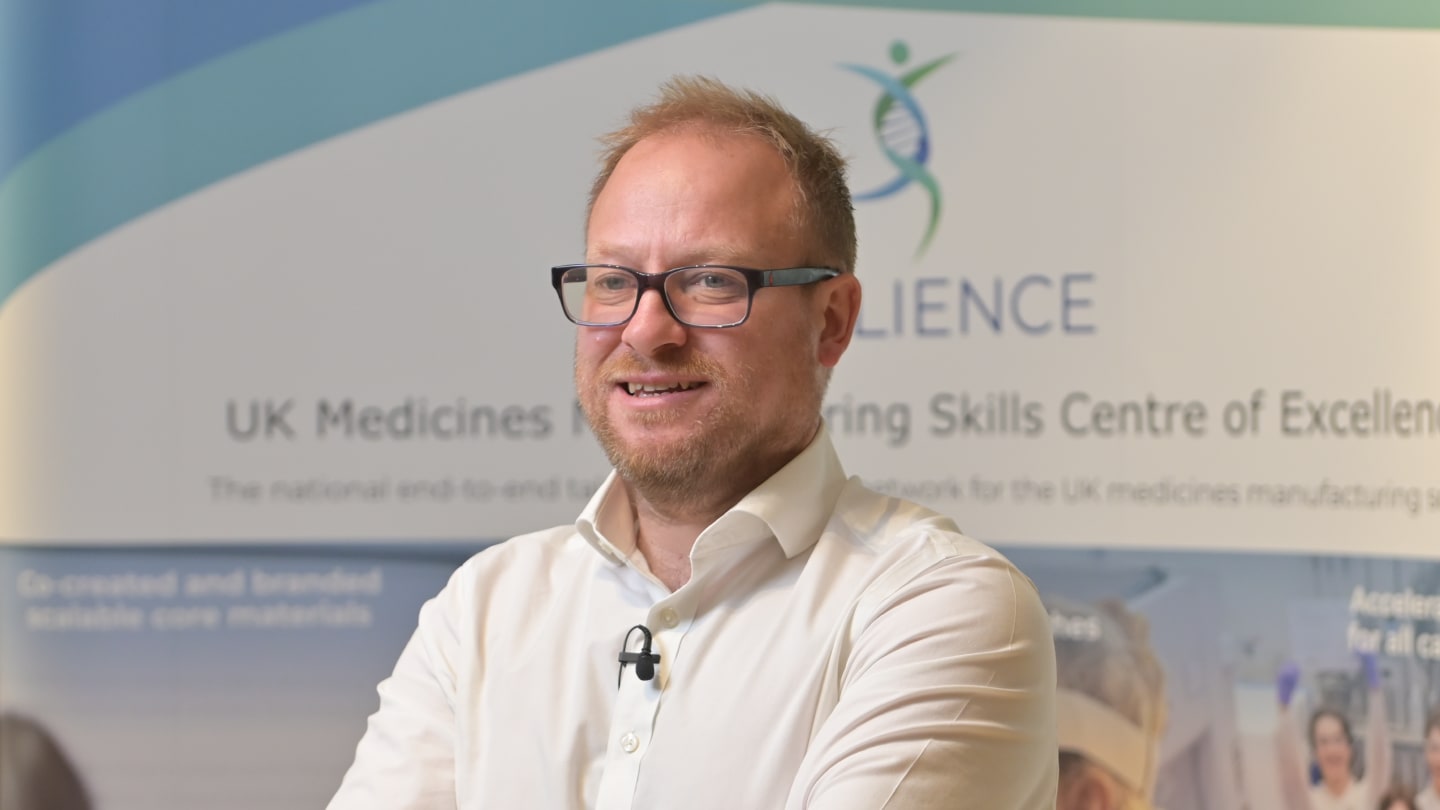
As access to labs becomes more expensive and skilled talent harder to retain, Professor Ivan Wall discusses how virtual reality is enabling faster, safer, and more scalable training for the next generation of medicine makers.
What are the core skills gaps in life sciences? And how do such gaps emerge?
The UK government’s ambition is for the UK to be leading life science nation in Europe by 2030 and 3rd in world by 2035. That being said, many reports say that skills gaps and evolving workforce needs that must be met before this goal is realistic.
The UK is losing ground in terms of its share of innovative medical research with the number of industry clinical trials initiated in the UK per year falling by 41% between 2017 and 2021.
Since 2010, the UK has fallen from 4th to 98th place in overall trade balance in pharmaceuticals; Merck (MSD), AstraZeneca, and Eli Lilly, have either cancelled or paused multi-million-pound projects: Merck (MSD) announced it would not proceed with its planned 1 billion pound research center in London’s Knowledge Quarter and AstraZeneca has taken similar steps, pausing a planned pound 200 million expansion of its Cambridge R&D site.
Other companies are also reconsidering their commitments. Eli Lilly and Sanofi have expressed similar frustrations with the UK market, which they see as undervaluing innovative medicines. In total, nearly 2 billion pounds in planned pharma investment has been frozen or abandoned in 2025 alone. The UK decline of global pharmaceutical giants means fewer partnerships with academic researchers, biotech startups, and loss of high-skilled talent to US or EU markets.
A report from the Cambridge Economic Policy Associates indicates the UK is losing business opportunities in life sciences sector because government undervalues the economic & social benefits of investing in the manufacturing of innovative medicines.
Some stats which give an idea of the skills gap
52% of engineering grads are from overseas.
64% of master’s students in chemical engineering are from overseas.
There is a forecast requirement in the industry of 145,000 new and replacement jobs in the Bio/Pharma industry in the next 10 years.
Some people associate VR with bulky, heavy headsets and distorted graphics. How is the technology improving?
It’s important to note that no matter how bulky a VR headset might seem, its inconvenience pales in comparison to the complex lab equipment, lab space and single use plastics that training medicine makers would require otherwise.
At the same time, VR is becoming sleeker and less bulky as headsets are made to be more comfortable with the ultimate goal of making them as wearable as standard glasses.
What particular skills are very suitable for teaching through VR?
Medicines manufacturing involves repetitive movements, making it particularly suitable for VR. In a real lab setting, every repetition would use new materials, chemicals and single use plastic, but the use of VR means an action can be practiced as many times as necessary.
Much of the core training is about orientation, building confidence, familiarity, and process knowledge, so VR is a highly efficient and cost-effective delivery method.
What are the advantages of using VR to teach core skills?
Many new drugs contain high-potency active pharmaceutical ingredients which present serious handling challenges and expensive specialized equipment is needed to protect employees and their environment from exposure. In addition, biologics (which includes vaccines, blood components, somatic cells and tissues) tend to be heat sensitive and susceptible to contamination, and the initial parts of the manufacturing process are particularly delicate.
All of these factors mean that medicines manufacturing is expensive, complex and time consuming. For trained technicians making medicines for use by real people, of course these factors are worth the inconvenience, but for trainees, VR provides a cheaper, more convenient method that allows them to make mistakes, repeat tasks and waste less.
Gaining access to laboratories themselves for training is also disruptive and expensive – people must travel there, training staff must be on-hand, working days are interrupted. VR technology dramatically reduces the dependency on real-world facilities, removing the need to consume expensive materials and enabling training anywhere at any time.
Training can be standardized across geographies and sites, and there’s no limit on class sizes. From cleanrooms to complex manufacturing tools, a VR-based tour of a real-world facility allows you to explore every corner with unprecedented detail and precision.
Are there any disadvantages?
VR lacks haptics, so we don’t get the "feel" elements of hands-on skills training. But it allows us to learn procedures in sequence through first person and immersive interactions.
What is the story behind the Resilience program?
The RESILIENCE program started in April 2024 and since then has achieved a significant level of training via outreach programs:
1,200 trainees attended industry relevant events led by RESILIENCE partners
13,500 students from across the UK participated in training and outreach activities through 170 events
75 future sector leaders from 23 organizations developed skills through the leadership accelerator programs
The VR environment used in the Resilience training program is based on one of the most advanced facilities in the country, the Cell & Gene Therapy Catapult’s manufacturing center in Stevenage.
What is involved in developing appropriate training programs and how have these programs advanced over the course of the program through feedback?
We have consulted widely with industry on where the gaps and needs are and then produced courses based on most advanced research and state of the art that we can.
We also aim to ensure our training programs are teaching future skills as more digital, automation and AI tools become central to medicines manufacturing. We gain detailed feedback from all trainees and, where we are working with other universities or further education providers, the staff who are leading their own courses using our tools and materials.
Newsletters
Receive the latest pharmaceutical news, personalities, education, and career development – weekly to your inbox.